How To Pick Between Scale vs Depth In Mental Health Innovation
By Harshali Paralikar · Feb 01, 2026
Hello friends,
I sit at my desk, a ginger lemon tea in tow as I once again bring the TinT newsletter to your inbox.
In the eight months of TinT, we’ve published 25 deeply researched newsletters, hosted one machine learning & mental health event and conducted an AI Psychoeducation workshop with trainee therapists at a reputed Indian educational institute.
We’ve also attracted all the right attention and blossomed into a small, multi-disciplinary team! To be so generously supported by all you readers is an honour – and a responsibility that I do not take lightly.
Along with your appreciation you've shared your feedback. As a response to that, this winter we’ve been underground, designing and developing our next steps. In the coming months, TinT will be focused on:
- AI Psychoeducation and AI literacy – for those of you eager to develop an understanding of how AI intercepts relationships and guides your clients into being mindful consumers of technology
- Critical Product Thinking & Building – for those of you who wish to apply yourselves toward building technology for mental health innovation.
Should you be more specifically interested in either or both of our above directions, reply to this email with the words AI PSYCHED and/or CRITICAL PRODUCT, and I shall get in touch with you.
Moving forward, you will find us in your inbox 2–3 times a month. As always, this newsletter will cover a wide gamut of topics and will continue to make you a technology-informed therapist.
Personally, TinT has been a dream in the making for the past 8 years. My 2019 vision board has ‘start something in the cross hairs of mental health and tech’ scribbled on it. Thank you for being a part of my story, our story, and the story of bridging two disciplines – machine learning and mental health.
With that, join me as we kickstart TinT’s 2026! :)
An Age-Old Argument: Scale Vs Depth
Should the industry lean into producing more tools and therapists as fast as possible, or insist on more evidence, better training, and careful standards before scaling?
Hark back to the time you first came across mental health innovation – the scale vs depth conundrum is perhaps one of the early dilemmas you might have confronted.
A Case For Scale
Circumstances that lead to Scale Mindset
There are 0.3 psychiatrists for every 100,000 persons in India. The numbers don’t get any better in the rest of Asian countries. [1] [2]
The person-to-provider ratio is extremely skewed in most eastern hemisphere countries. A tad better, but nowhere close to ideal in the Western hemisphere countries either.
Even in well-resourced settings, a large proportion (50% in US; 70–92% in India) of people who need care never reach a qualified professional. [3] [4] [5]
Problem areas that get tackled at scale
Scalers are often software tool builders. They tackle access problems: waiting lists, cost barriers, and geographic absence of specialists.
Asynchronous tools, generative-AI chatbots, and global platforms can extend some form of support far faster than workforce expansion.
At scale, tools are usually framed as self-help or early support rather than formal treatment.
Risks and benefits of solving for scale
Scale provides meaningful symptom relief for many and democratizes access. [6][7]
But the wins come with a catch.
Fast-scaling MhTech tools struggle with retention, inconsistent engagement, and delayed safety guardrails.
A Case for Depth
Circumstances that lead to Depth Mindset
Where scaling becomes risky, depth becomes important.
Think of how CBT core belief templates still require clinicians to know the client’s context.
AI tools often lack robust evidence that bias and unsafe responses are not baked in. [8]
LLMs inherit stigma from internet data while remaining opaque and apparently confident. [9] [10]
Problem areas that get tackled at depth
Depthers focus on safety, bias, explainability, privacy, security, and cultural validity.
They test edge cases such as suicidality, psychosis, and trauma.
Risks and benefits of solving for depth
Depth brings scientific rigor, ethical safeguards, and context-aware systems.
The tradeoff is speed. RCTs and regulation take years, risking academic isolation.
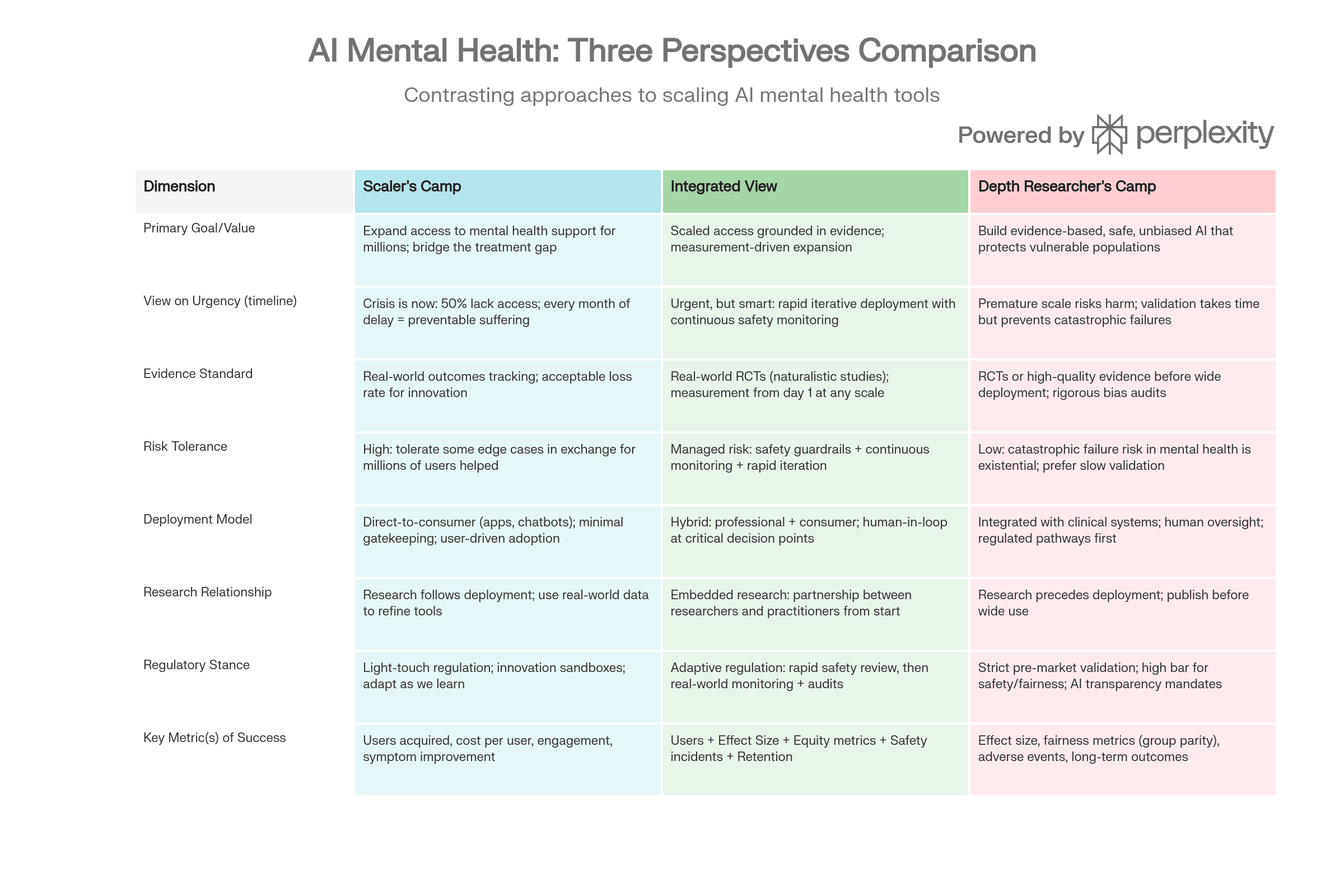
Both Sides and the Middle | Compiled by Perplexity AI
Bridging Scale and Depth
We need both scalers and depthers.
Scale can power depth through outcome feedback and longitudinal monitoring.
Depth can power scale when clinicians and researchers are embedded from day one.
What can you do?
The Key Design Principle: Co-Design
Co-design with clinicians and service users.
Practising psychologists can help define safe use cases and trials.
Students and trainees should build literacy and test systems critically.
Founders should use hybrid models where AI supports and clinicians lead.
Technologists must treat MH as high-stakes, with safety, escalation, and equity built in.
TinT’s Thoughts
AI will not rescue mental health systems alone.
We must build a bridge between scale and depth.
Those fluent in both clinical and technological worlds will be most needed.
Take care and see you soon,
Harshali
Founder, TinT
Follow on Insta @tintuitive_
Connect on LinkedIn