TinT Labs | Guiding Principles for MH-AI Founders & Builders
By Harshali Paralikar · Sep 14, 2025
Hello dear reader,
After many many boxes, bags, and a city change, we’re so back!
In case you missed it, I’m now living in Madison (Wisconsin), the charming isthmus city and capital of the dairy state.
Translation: I fully intend to eat all the ice cream there is.
For now, I’m sipping warm honey water, thrilled to be back at writing this newsletter!
Today we continue our TinT Labs five-part special series, co-written with two brilliant researchers who study AI and mental health.
And now, 'tis time for part 3.
When we brainstormed this piece, I asked Aseem (Postdoc) and Vasundhra (PhD):
What follows is their answer in the form of a letter, distilled from years of research, professional experience, and reflection. It’s both a call to action and a vision for building a safer future.
Dear founders and builders
of mental health AI,
We urge you to build collaboratively, market honestly, and engage critically.
- Define what you’re automating — and why. If the answer is unclear or fuzzy, pause and rethink the value you’re creating.
- Avoid the “move fast and break things” mindset. Ethical and social harms aren’t bugs to patch later. They’re preventable when you slow down and design with care.
- Be extremely critical of trends. Don’t rush to anthropomorphize your AI. Trends fade, but their impact on mental health is lasting.
- Build with an interdisciplinary team. Better data, models, design, business — and most importantly, better health outcomes — are worth the extra time.
- Don’t confuse “general-purpose” with “good enough”. Quick fixes are dangerous. Cultural adaptation, psycholinguistic awareness, and collaboration with clinicians are non-negotiable.
- Remember, you’re engineering human interactions, not just code. Culture, language, and context shape your model, and your model will shape them back.
- Involve users early. Participatory design and data justice are not afterthoughts. They’re foundations for safe, contextual systems.
- Be honest about your model’s limits. Accuracy alone isn’t enough, trust and positive health impact are the real indicators of success.
- Read widely across disciplines. Step beyond the tech circle. Humanities, journalism, and law will show you algorithmic harms you might miss.
- And finally, leave the field better than you found it. Open-source your datasets, share benchmarks, publish annotation guidelines. Technology best serves the public interest when its building blocks are open for others to improve.
These guidelines are reminder that the future of mental health tech is ours to shape, together.
You’re already part of that change – building the vocabulary, curiosity, and confidence to influence the tools of tomorrow.
I’d love for this message to travel far and wide!
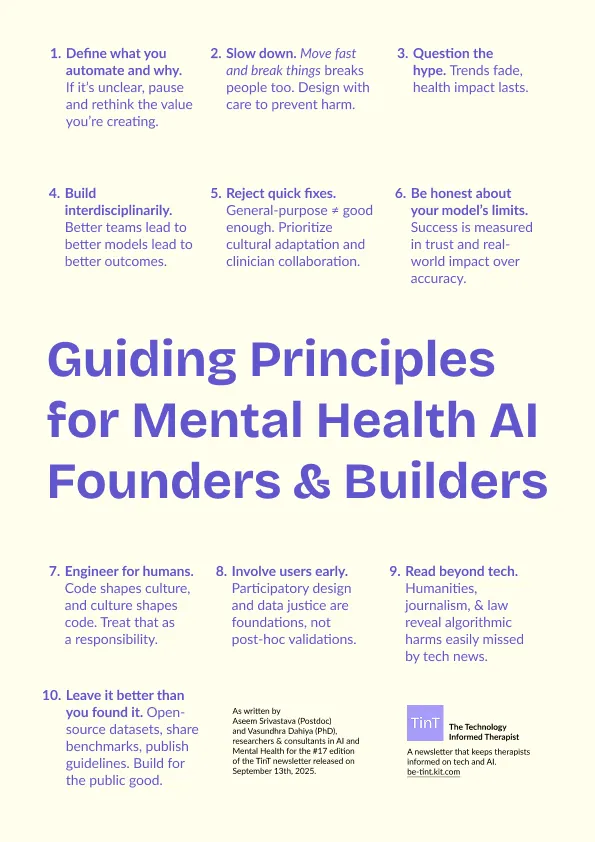
💬 Copy and post the above image and tag me or this newsletter
📥 Download a print ready version of it for your desk or clinic wall
🔗 Share it with a founder, builder, or technologist in your circle
Have a lovely week ahead,
Harshali
Founder, TinT